
Container Office Conversion Costs
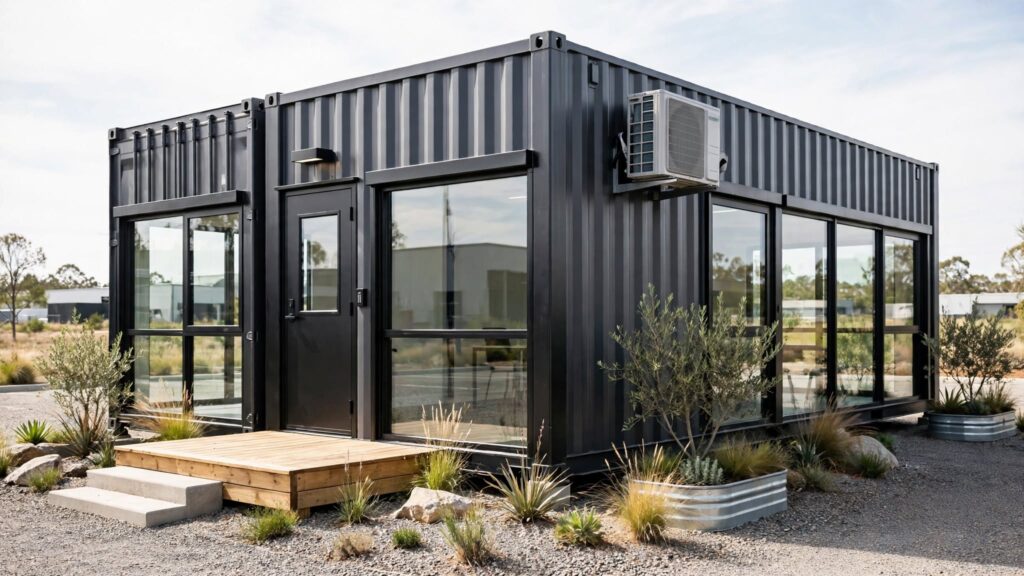
A container office looks simple from the outside. It’s a steel box with a door, windows, and air conditioning. The price difference between a cheap conversion and a good one is what you don’t see in the walls.
Here is a realistic cost breakdown.
1. The Base Container
This is your starting point. Everything else is built on top of it.
- One-Trip / New 20ft: Best for offices where image matters. Straight walls, no dents, no rust, no chemical smells. Easiest to insulate and convert. Longest lifespan.
- Wind & Watertight (WWT) 20ft: Cheaper, but you will spend more on prep — rust treatment, dent straightening, floor replacement. Only worth it if you have your own workshop.
- One-Trip 40ft: Most popular for a larger office. Gives you ∼28 sqm of usable space after insulation.
Rule of thumb: Don’t save money on the base. A bad box costs you more in labor than a good box costs to buy.
2. Conversion Cost Breakdown
For a standard 20ft office conversion, expect these 6 categories:
A. Cutting & Steelwork (15-20% of cost)
- Personnel door (steel security door with frame)
- Windows (aluminum sliding, with burglar bars)
- Ventilation cut-outs
- Reinforcing frames around cuts — critical, cutting weakens the structure
B. Insulation (15-25% of cost)
This is where cheap builds fail. A steel box is an oven in summer and a fridge in winter.
- Spray foam (closed-cell): Best performance, vapor barrier included, most expensive. R-value ∼6.5 per inch.
- Panel insulation (PIR / Polyiso): Good middle ground, clean finish, easy to install.
- Mineral wool + vapor barrier: Budget option, needs proper installation to avoid condensation.
Don’t skip: Insulation for walls, ceiling, AND under the floor.
C. Interior Finish (15-20% of cost)
- Plywood or drywall lining
- Vinyl or laminate flooring over the original wood floor
- Ceiling finish
- Painting inside and out
D. Electrical (15-20% of cost)
- Distribution board, breakers, earthing
- LED downlights
- Double plugs (4-6 for a 20ft)
- External waterproof plug point
- Pre-wiring for air conditioner
E. Climate Control (10-15% of cost)
- Air conditioning unit (12,000 BTU for 20ft is standard)
- Extractor fan or whirlybird for airflow
F. Extras That Make It an Office
- Built-in desk, shelving, cupboard
- Data / network points
- Security: Lock box, burglar bars, security door
3. Realistic Total Cost Ranges
These are global market averages for a complete, move-in ready unit:
20ft Basic Office
WWT container + basic insulation + 1 door + 2 windows + electrical + AC. No-frills site office. Lowest cost to get working.
20ft Standard Office
One-trip container + proper insulation + steel door + 2-3 windows + finished interior + electrical + AC + floor. What 80% of businesses buy.
20ft Premium Office
One-trip container + spray foam + premium finishes + full electrical with network + built-in furniture + external paint + security package. Client-facing, long-term use.
40ft Office is typically 1.6x to 1.8x the cost of a 20ft, not 2x — you save on delivery and some fixed labor.
40ft with Partition: Can be split into 2 offices or office + storage. Add partition wall cost.
4. Hidden Costs Most People Forget
- Delivery & Offloading: Crane truck needed if no forklift on site. Gets expensive with distance.
- Site Prep: Level the ground with concrete blocks or pavers. An unlevel container will twist and doors won’t close properly in 6 months.
- Condensation Prevention: If you don’t insulate properly and install a vapor barrier, you will get mold and dripping water inside. Fixing it later costs 2x.
- Certification: If used as a permanent structure, some areas require engineering sign-off for modifications.
5. How to Save Money Without Cutting Corners
- Choose a One-Trip container — less prep work = less labor.
- Keep the design simple: Fewer cuts = less welding and less structural reinforcement.
- Standard sizes: Use standard door and window sizes, not custom.
- Bundle: Buy container + conversion from one supplier. Buying a cheap box elsewhere and taking it to a fabricator almost always costs more in transport and rework.
- Plan electrical first: Decide where desk, AC, and plugs go before insulation goes in.
Bottom Line
A container office is not just a container with windows. It’s a small building.
The container itself is only 30-40% of the final price. The other 60-70% is what makes it usable, comfortable, and durable for 15+ years.
If a quote seems too cheap, check what they left out — it’s usually insulation, proper steel framing around cuts, and electrical safety.
Pro Tip: Ask your supplier for an itemized quote with these 6 lines: Base Container, Steelwork, Insulation, Interior, Electrical, AC. If they can’t break it down, they are guessing.